
- Home
- Dubai Travel Guide
- Dubai Public Transport Guide: Metro, Bus, Taxi & Tram Compared
- Dubai Travel Guide
- On 08.09.2026
- Nishith Kayath
- Tags dubai
Dubai Public Transport Guide: Metro, Bus, Taxi & Tram Compared
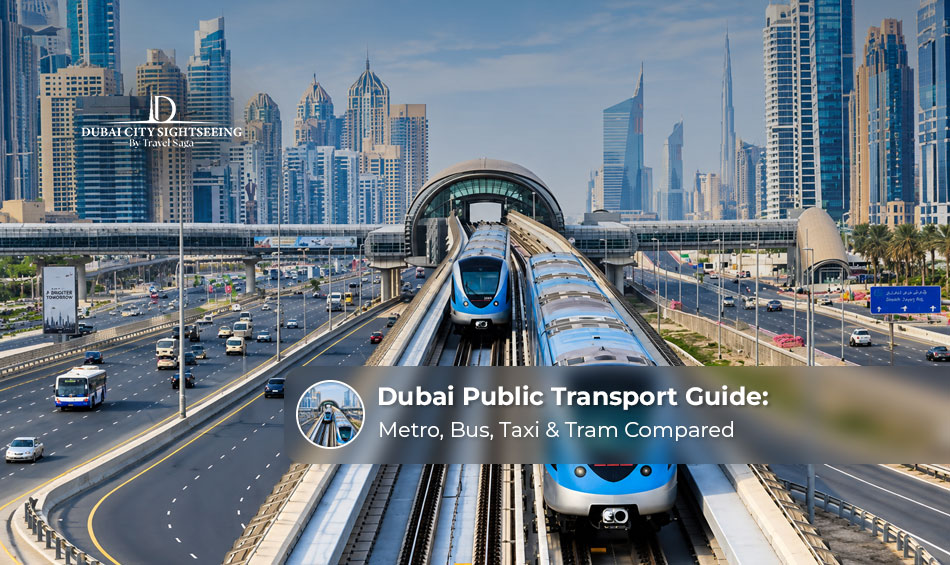
Renting a car is what most of the travellers do when they land in Dubai. However, this often leads to problems with traffic jams, mostly on Sheikh Zayed Road. On the other hand, if you consider public transport, you do not have to face problems like traffic jams. The best thing about public transport is that it covers almost everything that a tourist needs. The city is built around the attractions, and it connects almost every single attraction and tourist spot. This Dubai public transport guide takes you through every single thing that you need to know. With this, you and evelavte your experience better than ever.
Dubai Public Transport at a Glance
| If you want… | Best option |
|---|---|
| Cheapest way around | Metro or bus |
| Fast cross-city travel | Metro |
| Marina or JBR connections | Metro, then Tram |
| Door-to-door travel | Taxi |
| Airport transfer | Metro (Terminals 1 & 3) or taxi |
| Late-night travel | Taxi |
| One card for everything except taxis | Nol Card |
Dubai Public Transport Basics
Everything under Dubai’s Roads and Transport Authority- Metro, buses, tram, and water buses- runs on the Nol card system, a single rechargeable smartcard you tap in and out with. Public transport in Dubai stands apart from many other major cities specifically because of this unified card system. Taxis sit slightly outside this system since they are metered separately, though RTA regulates those too. Public transport is the best thing when on a Dubai tour package.
Enquire Now: Dubai Tour Package
Metro
The network currently runs two active lines, Red and Green, crossing at two interchange stations, Union and BurJuman, where you can switch platforms without leaving the paid zone. A third line, the Blue Line, is under construction and isn’t running yet, so ignore any map that shows it as active.
Where the Metro Doesn’t Actually Reach
This trips up more visitors than it should. Dubai Marina and JBR don’t have their own Metro station, despite how often people assume otherwise.
Going to Dubai Marina or JBR? Take the Metro to DMCC or Sobha Realty, then switch to the Dubai Tram for the final stretch along the waterfront. Which of the two stations you want depends on where you’re staying or which part of the Marina you’re headed to.
Getting to and from the Airport
Terminal 1 and Terminal 3 both have direct Metro access. Terminal 2 doesn’t, so anyone landing there needs a taxi or shuttle to reach the network. For a full walkthrough built specifically for first-time riders, this guide on how to use the Dubai Metro as a tourist covers station navigation, luggage rules, and gold-class cabin etiquette.
Bus
Dubai’s bus network runs over 150 routes across the emirate, reaching plenty of areas the Metro simply doesn’t touch. Feeder buses in particular exist specifically to connect residential areas to the nearest Metro station, and they run on the same Nol fare system, so no separate ticket is needed.
Tram
The Dubai Tram sits within a single fare zone for its entire route, meaning a standard Silver Nol journey costs a flat AED 3 regardless of how far you travel on it. It’s the connector most visitors end up using to actually reach JBR and the Marina promenade once they’ve gotten as close as the Metro allows.
The Monorail Isn’t Part of This System
Worth flagging separately: the Palm Jumeirah Monorail, run by Nakheel rather than RTA, doesn’t accept Nol cards at all. You’ll need a separate ticket bought online or at the station counter if that’s part of your route.
Taxi
Every licensed Dubai taxi runs on the same RTA-regulated meter, which makes pricing predictable even if it varies by time and pickup location. The main variables to know before you get in:
- Street hail, daytime: AED 5 flagfall, plus roughly AED 2.19 per kilometre
- Street hail, overnight: AED 5.5 flagfall, same per-kilometre rate
- App booking, off-peak: AED 5 flagfall plus an AED 4 booking surcharge
- App booking, weekday peak hours: AED 5 flagfall plus an AED 7.50 booking surcharge
- Airport pickup, saloon: AED 20 starting fare, regardless of time of day
- Airport pickup, van: AED 25 starting fare, regardless of time of day
Airport Taxis Cost More From the Start
Airport pickups carry that built-in surcharge no matter when you land, and app-booked taxis add their own separate charge on top of the flagfall. Hailing on the street is usually the cheaper option if one happens to be nearby.
Metro vs Bus vs Tram vs Taxi: A Direct Comparison
Putting all four options side by side makes the trade-offs much clearer than reading about each one separately.
| Mode | Typical Fare | Best For | Coverage |
|---|---|---|---|
| Metro | AED 3-7.50 per trip | Fast cross-city travel | Red & Green lines only |
| Bus | Same as Metro fares | Areas Metro doesn’t reach | 150+ routes citywide |
| Tram | Flat AED 3 | Marina and JBR specifically | Single route, one zone |
| Taxi | AED 12 minimum + AED 2.19/km | Door-to-door, late night | Anywhere, anytime |
Fares
Metro and bus fares both run on the same zone-based Nol pricing: AED 3 for one zone, AED 5 for two zones, and AED 7.50 for three or more zones on a Silver card. This zone system covers pricing across every mode except taxis. A daily spending cap of AED 14 applies to Silver cards, meaning once you’ve paid that much in a single day, every additional ride is free until midnight.
The Nol Card
The Nol card is what actually makes Dubai public transport function as one connected system rather than four separate networks. Four card types cover every situation:
- Silver: AED 25 (AED 19 usable credit), the standard choice, works across Metro, bus, tram, and water bus
- Gold: AED 25 upfront, but charges exactly double the standard fare per journey, in exchange for access to the quieter Gold Class cabins
- Blue: AED 70, discounted for students, seniors, and people of determination
- Red Ticket: AED 2, disposable, holds up to 10 trips over 90 days, best for a single short visit rather than repeat use
For a full breakdown of every card type and where to buy one on arrival, this guide to the Nol card explained covers pricing in more detail.
Best Option by Traveller Type
- Solo travellers and couples staying near a Metro line: Generally do best sticking almost entirely to Metro and tram, since both are fast, air-conditioned, and cheap enough that taxis become an occasional convenience rather than a default.
- Families with luggage or young kids: Often lean more on taxis for door-to-door convenience, accepting the higher cost in exchange for not managing strollers through station gates.
- Business travellers with tight schedules: Tend to mix both, using Metro for predictable point-to-point trips during the day and taxis for evenings when timing matters more than cost.
- Visitors staying multiple days who want a guided overview first: Sometimes start with a hop-on hop-off route before switching to independent Metro and tram use once they know the layout.
How to Get Around Dubai Without a Car
Skipping a rental car entirely is genuinely realistic if your hotel sits near a Metro station, since most major landmarks, Downtown, the Marina, Deira, and the airport, are all reachable through some combination of Metro, tram, and short taxi hops. Sightseeing-focused trips in particular work well without a car, since attraction density around Downtown and the Marina means walking fills most of the remaining gaps between transit stops.
For a structured first day getting oriented, a guided route removes the guesswork before you switch to independent travel. The Big Bus Tour Dubai covers major landmarks on a fixed loop, useful for getting your bearings before relying on public transport solo for the rest of the trip.
Enquire Now: Big Bus Tour Dubai
Choosing Between the Two Guided Formats
Both guided options cover similar ground, so the real choice usually comes down to how much flexibility you want on day one versus a fixed, narrated route.
Similarly, a flexible pass lets you hop off at whichever stop interests you without committing to a single day’s plan. Hop-on hop-off tickets work well paired with the Metro for exactly this kind of loosely structured sightseeing day.
Enquire Now: Hop-on hop-off tickets
Travelling from Dubai to Other Emirates
Dubai public transport covers the emirate thoroughly, but it stops at Dubai’s own borders. Getting to Abu Dhabi, Sharjah, or elsewhere in the UAE means switching to intercity transport rather than relying on the local Metro, bus, or tram network.
Rail is one option worth checking alongside intercity buses or a rental car. The Etihad Rail network is being developed to connect several emirates by train, though route availability and schedules are still expanding, so it’s worth confirming current service on your specific route before relying on it.
Timings
Getting stuck between the last Metro and a surge-priced taxi is an avoidable mistake, and timings are one of the easier things to check before you head out.
| Mode | Typical Operating Hours | Note |
|---|---|---|
| Metro | ~5 am–midnight most days, later on Fri/Sun | Confirm via RTA app for holidays and events |
| Tram | Broadly mirrors Metro hours | Individual services may vary slightly |
| Bus | Route-dependent | Check the specific route timetable |
| Taxi | 24 hours | Available regardless of Metro or bus schedules |
Exact hours shift slightly around holidays and major events, so checking the RTA app before an early morning or late-night trip is worth the thirty seconds it takes.
Common Mistakes
- Forgetting to tap out: The system calculates your fare based on both taps, not just the one at entry. Skip the exit tap, and you will be charged the maximum zone fare regardless of how far you actually travelled.
- Assuming Dubai Marina or JBR have their own Metro stop: They don’t, which leads to confused visitors circling a station that doesn’t exist. The nearest stations are DMCC and Sobha Realty, connecting onward via tram.
- Booking a taxi through an app during weekday peak hours: The same ride hailed off-peak or flagged directly on the street costs noticeably less once the booking surcharge is factored in.
- Relying on an old Metro map showing the Blue Line as active: It is still under construction, so any route planning that includes it will be wrong until the line actually opens.
Safety
Public transport in Dubai carries a strong safety reputation, with visible security presence across Metro stations and dedicated women-and-children carriages on every train. Taxis are metered and regulated, with driver ID clearly displayed, making overcharging or unlicensed pickups rare compared to many other major cities.
Verifying Current Fares and Timings
Fares, timings, and route maps shift periodically, and it’s worth checking directly with the source rather than relying solely on any blog, including this one, for numbers that matter to your specific trip. The Roads and Transport Authority’s official website publishes current fares, timings, and service updates directly from the government body running the entire network.
Conclusion
Most of the visitors visiting Dubai can solely survive using a Silver Nol card if they pair it carefully with the tram. This combination almost covers whatever most tourists need. Taxis fill in for late nights, luggage-heavy transfers, and anywhere the rail network simply doesn’t reach. You should avoid renting a car as long as your itinerary does not genuinely require a car. Using public transport is not only fast but cheap and reliable, making your journey smoother. Book your Dubai packages now with Dubaicitysightseeing.com and enjoy the best moments of your life.
Frequently Asked Questions: Dubai Public Transport
For most tourist itineraries, yes. Downtown, the Marina, and the airport are all well connected by Metro and tram, with taxis covering the remaining gaps.
Buy a Silver Nol card on arrival, use the Metro and tram for the bulk of your trip, and keep taxis in reserve for late nights or heavy luggage.
A Nol card works on the Metro, bus, tram, and water bus. Taxis use a separate metered payment system.
Rarely for solo travellers, though splitting a short taxi ride across three or four people can sometimes come close to combined Metro fares for the same group.
Forgetting to tap out of the Metro or tram, which triggers the maximum zone fare instead of the actual distance travelled. For more related queries, visit our Frequently Asked Questions page.
Visit Our Office: Get Direction